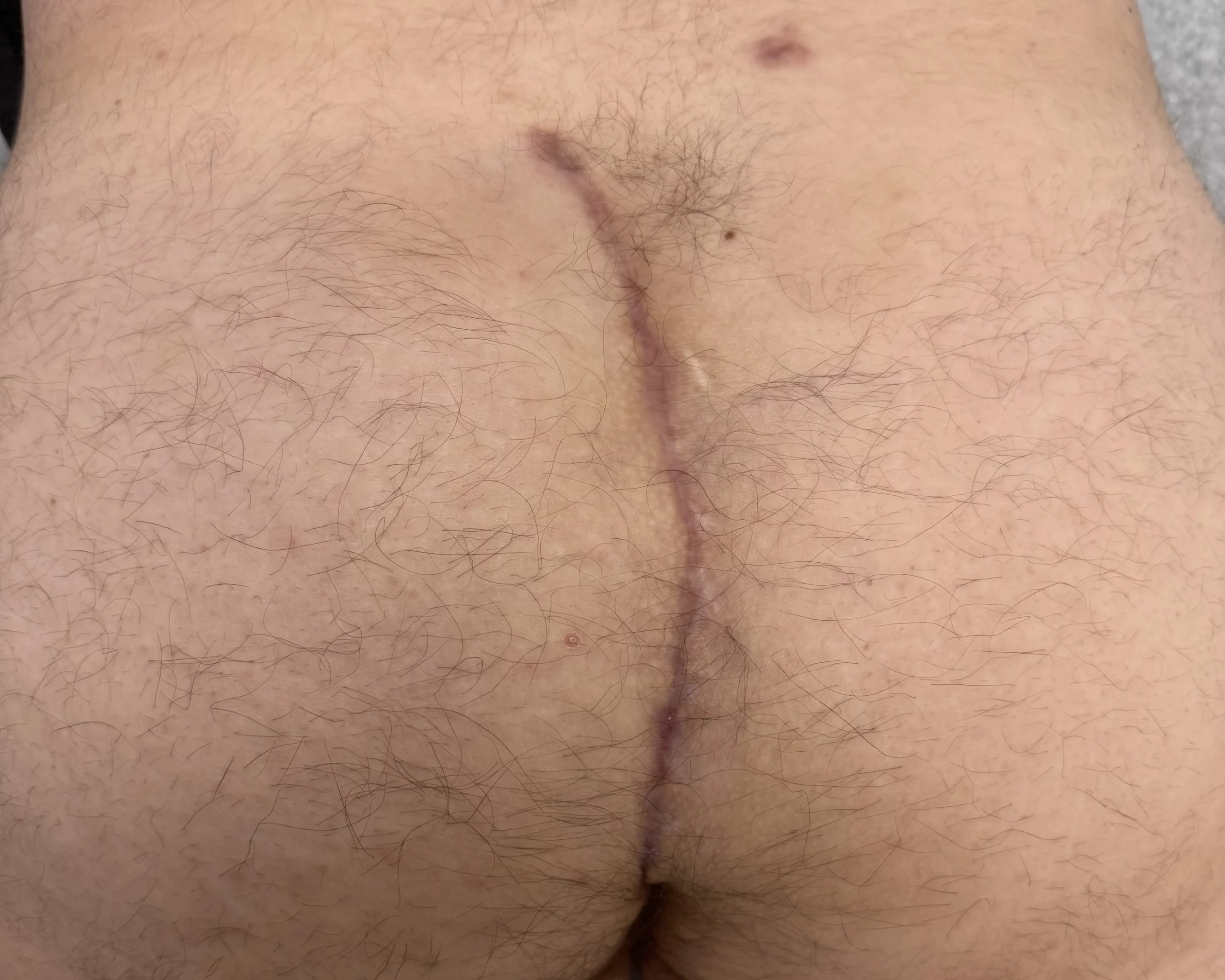
Pilonidal sinus is the term first used by Hodges in 1880 to describe a granulomatous lesion containing hairs. It has been previously described as hair extracted from an ulcer andreferredtoasJeep’s disease, in world war days. Pilonidal sinus is the condition in which a sinus or fistula is situated at a short distance from the anus and generally contains hairs. It is commonly observed in the sacrococcygeal region and a few other sites, such as the axilla, umbilicus, face, etc. Its presence elsewhere is uncommon. Predisposing factors are traumatized, hairy skin, which leads entry of the hair inside the wound, thus forming a sinus. A 31-year-old patient presented with discharging endoanal sinus tract, which, on exploration, turned out to be an endoanal pilonidal sinus containing hair tufts, a rare case. The patient complained of recurrent pus discharge and anal pain for 45 days, reporting history of travelling around 70 km daily in a two-wheeler vehicle.




Results: Eight hundred seven individuals, 539 (66.8%) with and 268 without BAD were analysed. Almost one third (31.2%) of patients with BAD had more than one BAD. Concomitant anal findings such as skin tags were more frequently seen in patients with than without BAD (<0.01). After haemorrhoids (401 patients), pruritus ani (317 patients) was the second most frequently found BAD. The distribution of stages in 317 pruritus ani patients was: mild (91), moderate (178), severe (29), and chronic (19). Anal symptoms in patients with BAD included: bleeding (58.6%), itch (53.7%), pain (33.7%), burning (32.9%), and soreness (26.6%). Anal lesions could be predicted according to patients' answers in the questionnaire: haemorrhoids by anal bleeding (p=0.032), weeping (p=0.017), and non-existence of anal pain (p=0.005); anal fissures by anal pain (p=0.001) and anal bleeding (p=0.006); pruritus ani by anal pain (p=0.001), itching (p=0.001), and soreness (p=0.006).
History taking does not lead to accurate anal diagnoses [,]. It is also unknown which examination position (i.e. left-lateral, knee-chest, lithotomy or the upright standing-bented) is the most reliable for determining the causes of anal bleeding, anal itch, anal pain or anal burning. The sensitivity, specificity and predictive value of patients' positioning in diagnosis of BAD, concomitant anal findings (CAF), and multiple anal lesions (MAL) with one individual also remain unknown [,,]. We investigated the types and frequencies of anal complaints with respect to anal findings at proctologic assessment using the knee-chest position in contrast to the widely used left lateral Sims' position to evaluate its pros and cons.
Hairy anus. Hairs spread out almost carpet like to the anal verge (definition table ).
To determine whether certain symptoms could serve as predictors of BAD, we used binary logistic regression analysis. The database consisted of all 17 symptoms described in the questionnaire (table ): Haemorrhoids were predicted by anal bleeding (p=0.032), anal weeping (p=0.017), non-existence of diarrhoea (p=0.008), and anal pain (p=0.005). Thrombosed external haemorrhoids were predicted by anal lumps (p<0.001) while anal bleeding (p=0.010) was absent. Anal fissures were predicted by anal pain (p<0.001) and anal bleeding (p=0.006) in the absence of anal weeping (p=0.033). Pruritus ani was predicted by anal pain (p<0.001), anal itch (p=0.001), and anal soreness (p=0.006).